Documentary Studies concentration launches at The W
Ken Burns. Amy Berg. Werner Herzog. Students at Mississippi University for Women have the opportunity to study these and many other documentarians, and follow in their footsteps, with the new documentary studies concentration and minor, both of which launched this fall.
“There’s a real demand for more meaningful stories,” said Dr. Barry Smith, chair of the Department of Communication. “We’re looking at a way to teach students how to effectively tell those stories in addition to the normal writing and production skills that we already give students going in the various communication industries.”
As far as the course load, there is very little difference.
“They’ll take the normal writing and production classes that the comm students take, and then an extra research class, extra film classes and then a capstone project class that will result in a documentary film,” Smith said.
The film classes include studying documentaries throughout the years and how the medium has evolved.
The idea for the program came from faculty noticing trends in the communication landscape.
“There’s a real demand for more meaningful stories,” Smith said. “We’re looking at a way to teach students how to effectively tell those stories in addition to the normal writing and production skills that we already give students going in the various communication industries.”
The program works in conjunction with the Department of History, Political Science and Geography to offer a history methods class, which helps build the skills necessary to do the in-depth research required to produce a documentary.
In the capstone class, the students plan and produce a full-length documentary on a subject of their choosing. Students in the minor are not required to take the capstone course unless they choose to.
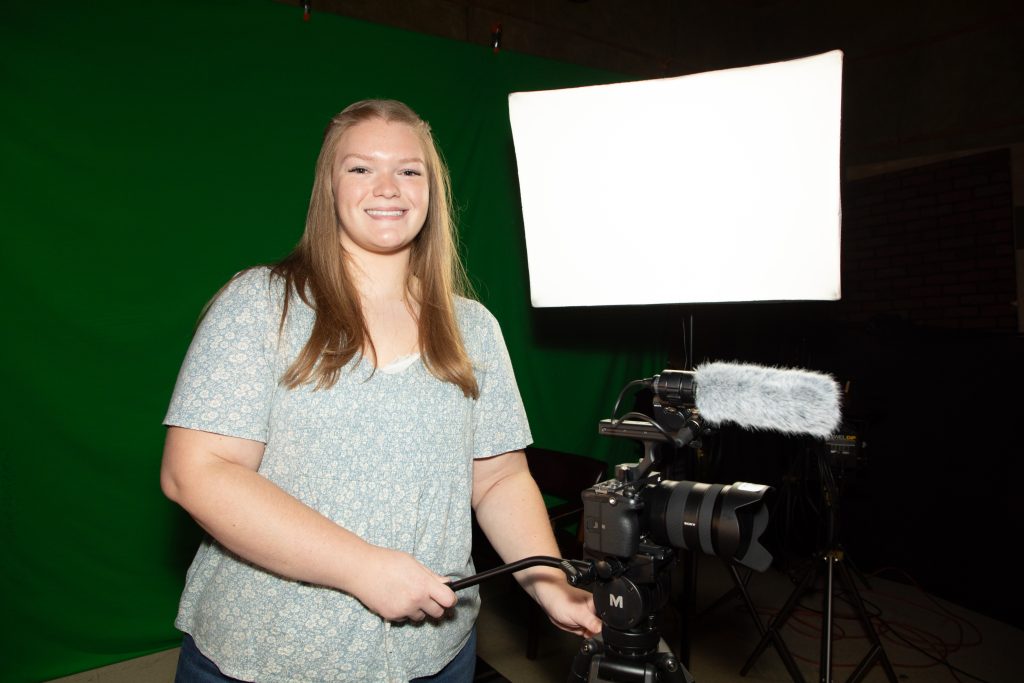
The documentary is filmed using new equipment the department purchased specifically for the documentary studies program.
“The university graciously helped us update some equipment that we really needed to in order to create the kind of end quality for the projects that we need,” said Smith. “The equipment we have meets the technical standards for Netflix and other streaming platforms.”
The idea being that students could potentially have their completed documentaries on one of those platforms, while simultaneously giving them experience with cinematic-grade equipment.
That experience is one of the factors which appealed to Emma Brown, the first student in the concentration.
“I am hoping to work toward a job in the filmmaking industry or the world of entertainment journalism, hopefully in Mississippi or across the southeast,” Brown said. “My experience with Documentary Studies will be a big boost in my understanding of the research that goes into the storytelling element of both filmmaking and journalism.”
Brown, a senior communication major has taken all of the courses in the major except for the capstone as the classes were offered prior to the concentration being added to the academic offerings at The W.
“Being in the documentary studies courses has allowed me to explore different forms of nonfiction storytelling that I had not previously studied in depth,” she said. “The classes included under the concentration have brought so many of my interests together into something that has already proven to be beneficial to the way I approach my academics and the work toward my future career goals.”
While Brown is the first student in the concentration, it is open for more to join. To join the concentration, a student would change their major to communication and then declare the concentration. The minor, however, does not require a change of major and is open to all students across campus.
To inquire about joining the program, please contact Smith via email at bpsmith@muw.edu.