Three Women Writers: George Eliot, Eudora Welty, Virginia Woolf
October 3 – November 12
Three Women Writers features portraits of George Eliot, Eudora Welty, and Virginia Woolf, each in very different representations.
Eudora Welty, known for her keen observations of Southern life, is photographed by Mark Morrow for his book Images of the Southern Writer (1985). In Morrow’s photograph, Welty casually leans back in a chair that she only used for speaking on the telephone, hand to her chin, apparently lost in thought.
Her literary debut was in 1936 with a short story in the literary magazine Manuscript. Her best known short story, however, is “Why I Live at the PO,” which is widely anthologized. She won numerous awards for her writing, including a Pulitzer Prize for Fiction for The Optimist’s Daughter (1969; 1972).
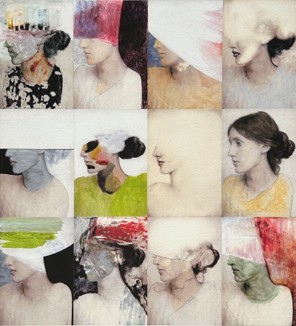
Virginia Woolf 370, from 2002, features the English writer who is best known for her novels Mrs. Dalloway (1925), To the Lighthouse (1927), and the feminist A Room of One’s Own (1929). Woolf is credited with helping to establish a nonlinear, or stream of consciousness, approach to narration as a literary device.
The print of Woolf features one of the most famous images of the writer in a grid with artistic interpretations of the original. This portrait of Virginia Woolf, by New York artist Linda Stein, is our newest acquisition in this exhibition.
The drawing of George Eliot, from 1860, is by Samuel Laurence, an artist who specialized in portraits of Victorian writers. Known by her pen name of George Eliot, Mary Ann Evans grew up in rural England. She received formal education up to the age of sixteen, after which she continued her studies independently through her voracious reading, often of Greek tragedies. Her early life and education influenced her novels, the most celebrated of which is Middlemarch (1871 – 1872). Eliot is considered one of the most important of the Victorian writers.